

Most organisations already have wellbeing resources. But are we helping people recognise when they need them and how to access them? You’ve invested in wellbeing; I believe now we need to help your people put that wellbeing awareness into practical action.
Over the years, I’ve worked with hundreds of organisations across a wide range of sectors, from household names to businesses you’d likely come across every day. One thing I’ve consistently observed is this: the challenge is not usually a lack of wellbeing support.
In many cases, the resources are already there. There may be policies, employee assistance programmes, benefits, mental health support and internal guidance. The real challenge is helping people apply those resources in a way that is practical, timely and relevant.
In other words, how do we make wellbeing support usable?
Support only works if people know when and how to use it
Many organisations have invested significantly in employee wellbeing, particularly in recent years. That investment matters and it is important. But the presence of support does not automatically mean it is being used confidently or consistently.
Employees may not always recognise the signs that something needs to change. They may know they are tired, stretched or not feeling quite themselves, but struggle to pinpoint what is driving it or what action to take.
Managers may notice a shift in behaviour, energy or performance, but not know what to do with that observation. Is it a passing blip, or the early sign of something more? Should they raise it? If so, how? What should they ask? And what is the appropriate next step?
These are not small questions. They sit at the heart of how organisations create sustainable, high-performance cultures, rather than burnout-driven ones.
Particularly since Covid, many managers have found themselves trying to balance the competing tensions of wellbeing and performance. They are expected to support their people, deliver results and keep teams moving forward, often without feeling fully equipped to have conversations around stress, overwhelm or burnout.
And as I’ve said before, I’ve yet to meet a business that does not describe itself as a high-performance environment.
That is exactly where the Cadence Toolkit comes in.
Turning wellbeing awareness into practical action
The Cadence Toolkit has been developed to help organisations bridge the gap between having support available and helping people use it well.
Built around the Cadence Approach, it gives employees, managers and leaders practical ways to understand what is happening, where pressure may be building and what action to take next.
At its heart are three connected levels of support.
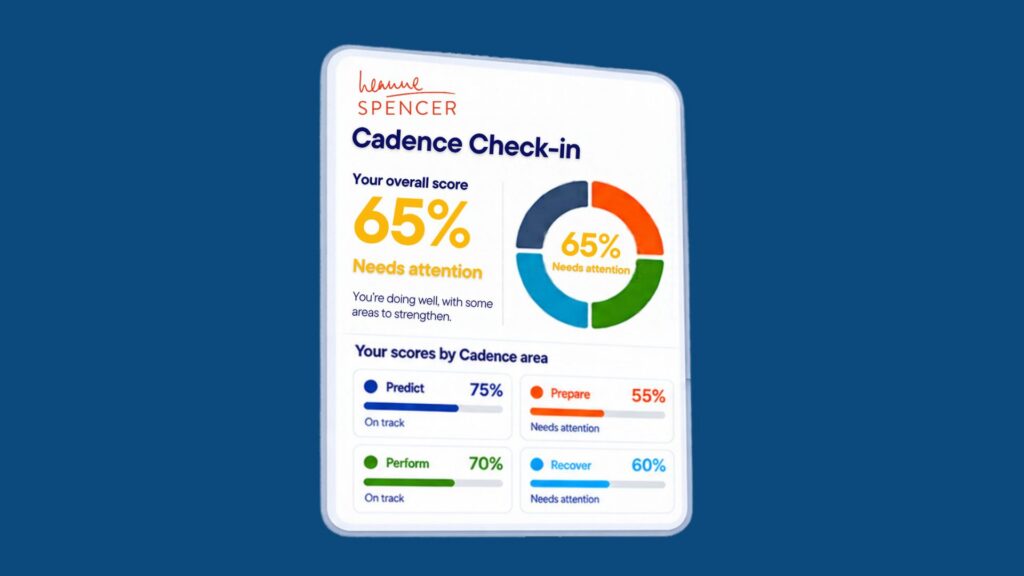
1. Employee Cadence Check-in
The first part of the Toolkit is the Employee Cadence Check-in.
This is a private scorecard that allows individual team members to discreetly reflect on how they are doing across the four areas of the Cadence Approach: Predict, Prepare, Perform and Recover.
The purpose is to help employees assess their current state and gain useful insight into where they may be doing well and where they may need more support or areas to pay attention to, with practical advice and insights.
This matters because people do not always recognise the signs early enough. A private check-in gives them space to pause, reflect and better understand what may be contributing to how they feel.
It is a practical first step that helps turn vague feelings into clearer insight, with actionable suggestions on ways to make positive steps towards better wellbeing, both inside and outside of work.
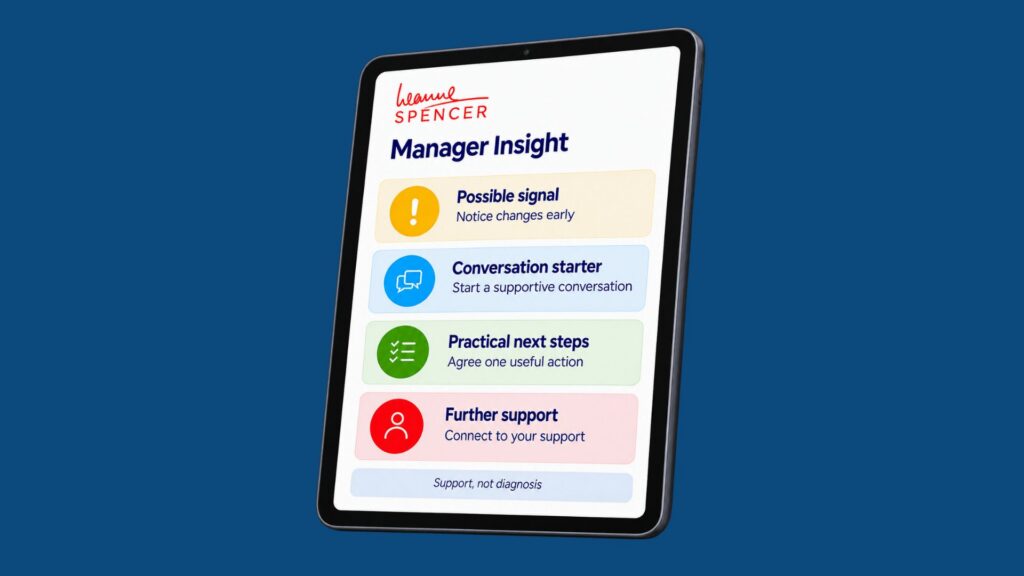
2. Manager Insight Tool
The second part of the Toolkit is the Manager Insight Tool, and I think this is particularly valuable. This is the piece we have especially been asked for. How can we help managers have those difficult conversations, know what to ask and understand where the issues may lie?
Most managers want to support their people. The challenge is that they don’t always know how.
Perhaps a team member seems quieter than usual, their performance has dipped, or they’re working longer hours. Something feels different, but is it an early warning sign or simply a difficult week?
And even when managers recognise that something may be wrong, there are often more questions than answers. The Manager Insight Tool gives managers a practical framework to move from observation to action, helping them:
- Recognise meaningful changes: Understand the behaviours and patterns that may indicate someone needs additional support, while also recognising positive signs of wellbeing.
- Build confidence in conversations: Access practical prompts and guidance to approach sensitive discussions with empathy and without making assumptions.
- Explore contributing factors: Use the four stages of the Cadence Approach, Predict, Prepare, Perform and Recover, to consider where pressure may be building or where existing habits and resources are supporting wellbeing.
- Identify appropriate next steps: Explore practical adjustments, agree supportive actions and understand when additional help or escalation may be needed.
Managers can reflect privately on what they’ve observed and receive guidance relevant to the situation, including signposting to internal and external wellbeing resources.
The aim is to make supportive conversations easier to initiate and more useful when they happen.
It’s not about asking managers to diagnose problems or become wellbeing experts. It’s about giving them the confidence, language and practical tools to support their people proactively, before challenges become more difficult to manage.
This helps managers approach conversations with more clarity and confidence. It also helps them move beyond a general sense that something is wrong and begin to understand where support may be needed.
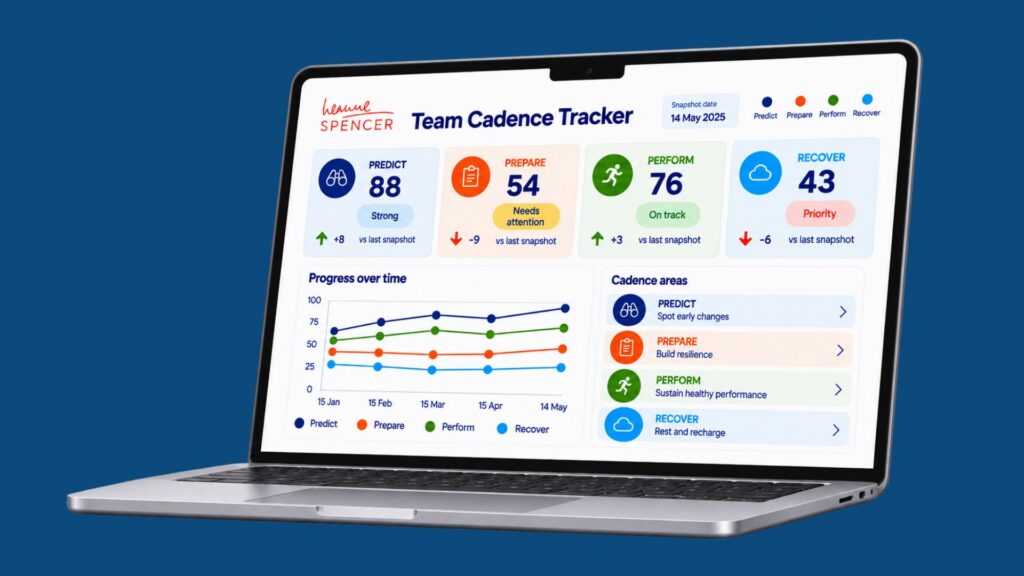
3. Team Cadence Tracker
The third component is the Team Cadence Tracker.
This gives managers and leaders a practical way to see, at a glance, how their team is performing across Predict, Prepare, Perform and Recover.
It brings together a broader picture of team wellbeing and performance so leaders can identify patterns, spot strengths and focus their support where it will have the greatest impact.
For example, a team may be very strong in Predict. They know when their big moments are coming. They know when their ‘Wimbledons’ are. But they may be less strong in Prepare or Recover. Or there may be a wider team perception that every day feels like a Wimbledon, which creates a very different kind of challenge.
The Team Cadence Tracker helps surface these patterns.
It gives leaders a clearer sense of where the team is thriving, where pressure may be building and what conversations or actions are needed next. It also makes it easier to distinguish between team-wide themes and issues that may be affecting specific individuals.
A more connected approach to wellbeing and performance
What makes the Cadence Toolkit different is that it connects three vital perspectives:
- Individual reflection
- Manager support
- Team insight
Too often, these sit separately.
Employees are expected to manage their own wellbeing. Managers are expected to support people, sometimes without the right tools or insights. Leaders are expected to understand how their teams are doing, often without a clear or repeatable way of seeing the whole picture.
The Cadence Toolkit brings those strands together.
It is not about replacing the resources organisations already have. It is about helping people use them more effectively, at the right time and in the right way.
From resource-rich to action-ready
Many organisations are not lacking support. They are lacking a practical way to help people turn that support into practical action.
That is why we’re creating the Cadence Toolkit.
It helps employees recognise when something needs attention. It helps managers feel more confident spotting early signs and having supportive conversations. And it helps leaders understand where their teams are strong, where they may be stretched and where targeted action could make a real difference.
In short, it helps turn wellbeing awareness into practical action.
Be among the first to introduce the Cadence Toolkit
The Cadence Toolkit is designed to help organisations create a more practical, connected and sustainable approach to high performance.
We’re inviting a small number of organisations to register their interest ahead of the first rollout of the Cadence Toolkit.
If you’re responsible for HR, Learning & Development, organisational culture or workplace wellbeing, or you’re a people leader looking for more practical ways to support your team, we’d love to hear from you.
This is an opportunity to explore how the Cadence Toolkit could complement your existing wellbeing resources, equip managers with greater confidence and help create a more sustainable high-performance culture.
By registering your interest, you’ll have the opportunity to:
- Connect directly with me to discuss your organisation’s needs and priorities.
- Explore the Cadence Toolkit and how it could support your people.
- Gain priority access to the first rollout opportunities and find out more about founding-partner terms.
There’s no financial commitment to register, just an opportunity to explore how we can make wellbeing support more proactive, practical and accessible.